Dassault Systemes Deutschland GmbH

Deutschland

Video

Entry, Sustainable Aviation Competition: The Jets - 'Implementing Chevron Nozzles to Reduce Noise'

The Jets entry to the Dassault Systemes Sustainable Aviation Competition. Project Description: Environmental concerns and strict noise regulation around airports, have made jet engines noise a crucial problem in the present day. According to research, jet engine noise is at its maximum during take-off, in which the exhaust condition may become under expandable. The current jet noise research is focus in three main sector improvement in noise prediction tolls, better understanding in noise generation mechanism and investigation in noise reduction design. While the design of noise reduction strategies, the flight requirements such as weight, thrust and performance (loss of engine) must be kept in mind. A turbofan engine derives 70% of its thrust from the huge fan at the front. The air fan thrown back is not all sent in the compressor, most of it bypass the jet engine and exit at the same extremity of the hot stream. The air coming from the back of the engine is very hot and the velocity of the exhaust stream is very noisy. The current chevron design is the revolutionary design for noise reduction in jet engines. There it was decided that the project would be to modify the chevron nozzle zig-zag shape. Don’t forget to subscribe: https://goo.gl/bDS7oS Dassault Systemes official website: http://www.3ds.com/ Follow us! Facebook: https://www.facebook.com/DassaultSystemes Twitter: https://twitter.com/Dassault3DS Linkedin: https://www.linkedin.com/company/dassaultsystemes

Video

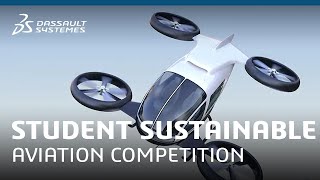
Competition Winner, Dassault Systemes Sustainable Aviation Project: Team Ela - 'Beamliner'

"Team ELA's submission to the Dassault Systemes, Sustainable Aviation Competition. Project Description: The project was centred around the use of beamed power (the transmission of energy from a grounded source via electromagnetic radiation to a receiver on the aircraft) to extend the range of a battery-powered electric aircraft seating around 50 passengers. Beamed power was to be used during the take-off and climb sections of flight, eliminating drain on the battery during the most power-intensive sections of the flight. The range was further increased by using a blended wing body and ducted fans to optimise the aerodynamics of the aircraft. These range increases were essential to the business case of the aircraft, as they would allow the aircraft to service popular regional routes such as London-Amsterdam or other European routes which are currently beyond the range of electric aircraft. Developing the range and capacity to service these routes with electric aircraft earlier than traditional designs whose progress relies heavily on battery energy density increases would allow this aircraft to make rapid progress in this market largely free from competition until other approaches caught up. Additionally, improvements to pure battery-powered aircraft range could be enjoyed by the beamed power aircraft since it relies on battery power for the cruise phase of flight." Don’t forget to subscribe: https://goo.gl/bDS7oS Dassault Systemes official website: http://www.3ds.com/ Follow us! Facebook: https://www.facebook.com/DassaultSystemes Twitter: https://twitter.com/Dassault3DS Linkedin: https://www.linkedin.com/company/dassaultsystemes

Video

Entry, Sustainable Aviation Competition: Team Theia - Quick Release/Swappable Battery Pack Structure

Team Theia's submission to the Dassault Systemes Sustainable Aviation Competition. Project Description: The rise of low-cost airlines which follow the point-to-point model of flight (compared to the tradition hub-and-spoke method) and maintain a single-model fleet of smaller aircraft shifts the focus to high operational efficiency (less time on ground). To power a 15000 kWh battery which is the approximate requirement to operate an Airbus A220 to fly for 1000 km, the charging time would be about 4 days on the same fast charging system (150-200 kW) as Tesla cars use. The idea is to develop swappable battery structures to solve the aforementioned problem. Swapping batteries at airports allows the aircraft to quickly refill its energy and fly to another destination without waiting for the battery to be recharged while the battery itself can be charged at the airport with specialised infrastructure away from the aircraft for safety. For airlines, swappable battery packs can allow them to improve, or at least retain, the old flight schedule after the electric transition. These also allow airlines to reap the benefit of electric propulsion: quieter flights and lower operating costs with less critical infrastructure and the predicted rise of renewable energy. Don’t forget to subscribe: https://goo.gl/bDS7oS Dassault Systemes official website: http://www.3ds.com/ Follow us! Facebook: https://www.facebook.com/DassaultSystemes Twitter: https://twitter.com/Dassault3DS Linkedin: https://www.linkedin.com/company/dassaultsystemes

Filtern

Suchbegriff

Unterkategorie

Firmen

Inhaltstyp

Firmentyp

Land